Showing posts with label Educating Yourself. Show all posts
Wednesday, April 15, 2020
Thor, St.Boniface and the Christmas Tree
When the average person thinks of a Catholic saint, I’d venture to guess that it’s not a fearless, axe-wielding, hammer-breaking, oak-crushing, converter of heathens that comes to mind. And yet, that’s exactly the kind of guy St. Boniface was.
Born around 680 in England, Boniface entered a Benedictine monastery before being commissioned by the pope to evangelize modern-day Germany, first as a priest, and eventually as a bishop. Under the protection of Charles Martel, Boniface traveled through all of Germany, restrengthening regions that had already been introduced to Christianity and bringing the light of Christ to those that hadn’t. Boniface, “with his tireless activity, his gift for organization, and his adaptable, friendly, yet firm character,” found a great amount of success in his travels, said Pope Benedict XVI in 2009.
Here Boniface is described (albeit dramatized for story-telling) by Henry Van Dyke in The First Christmas Tree (1897),
“What a man he was! Fair and slight, but straight as a spear and strong as an oaken staff. His face was still young; the smooth skin was bronzed by wind and sun. His gray eyes, clean and kind, flashed like fire when he spoke of his adventures, and of the evil deeds of the false priests with whom he contended.” (1)
Around the year 723, Boniface was traveling with a small party in the region of Lower Hesse. He knew of a community of heathens near Geismar who, in the middle of winter, would make a human sacrifice (a child, typically) to the thunder-god Thor (yes, THAT Thor) at the base of their sacred oak tree, the “Thunder Oak”. Boniface, in part from advice from a brother bishop, wished to destroy the Thunder Oak to not only save the life of the human sacrifice, but also to show the heathens that he would not be struck down by lightning at the hands of Thor.
As the story goes, Boniface and his companions, reaching the village on Christmas Eve, arrived at the place of the sacrifice in time enough to interrupt it. With his bishops’ staff (crozier) in hand, Boniface approached the pagan crowd, who had surrounded the base of the Thunder Oak, saying to his group, “Here is the Thunder Oak, and here the cross of Christ shall break the hammer of the false god, Thor.”
With a small child laid out for the sacrifice, the executioner raised his hammer high. But on the downswing, Boniface extended his crozier to block the blow, miraculously breaking the great stone hammer and saving the child’s life.
Afterward, Boniface is said to have proclaimed to the people:
“Hearken, sons of the forest! No blood shall flow this night save that which pity has drawn from a mother’s breast. For this is the birth-night of the Christ, the son of the Almighty, the Savior of mankind. Fairer is He than Baldur the Beautiful, greater than Odin the Wise, kinder than Freya the Good. Since He has come sacrifice is ended. The dark, Thor, on whom you have vainly called, is dead. Deep in the shades of Niffelheim he is lost forever. And now on this Christ-night you shall begin to live. This blood-tree shall darken your land no more. In the name of the Lord, I will destroy it.” (2)
Boniface picked up an axe nearby and, as legend has it, took one mighty swing at the oak when a great gust of wind arose through the forest and felled the tree, roots and all. It lie on the forest floor, broken in four pieces. Though afterwards Boniface had a chapel built from the wood, our story takes us to what stood immediately beyond the ruins of the mighty tree.
The “Apostle of Germany” continued to preach to the astounded Germanic peoples, who were in disbelief that this slayer of Thor’s Thunder Oak had not been struck down by their god. Boniface looked beyond where the oak lay, pointing to a small, unassuming fir tree, saying:
“This little tree, a young child of the forest, shall be your holy tree tonight. It is the wood of peace… It is the sign of an endless life, for its leaves are ever green. See how it points upward to heaven. Let this be called the tree of the Christ-child; gather about it, not in the wild wood, but in your own homes; there it will shelter no deeds of blood, but loving gifts and rites of kindness.” (3)
And so, the Germans began a new tradition that night, one that stretches to the present day. By bringing a fir into their homes, decorating it with candles and ornaments, and celebrating the birth of a Savior, the Apostle of Germany and his flock gave us what we now know as the Christmas tree.
Taken from Churchpop
Tuesday, April 14, 2020
Early Christianity in Iran and China
Nestorian missionaries
Christianity is growing in modern-day China and Iran, but it is not a new religion to these regions. As early as the 7th century AD, Christianity had spread to the Arabian Peninsula (most notably Persia - modern day Iran), India and China. It was spread by Nestorian missionaries.
Nestorianism was a Christian doctrine advanced by Nestorius, Patriarch of Constantinople from 428–431 AD. Because there were doctrinal differences between the Nestorians and the Roman Catholic Church, the Nestorians branched out, spreading the Christian faith to Persia.
"Missionaries established dioceses in the Arabian Peninsula and India (they were known there as Saint Thomas Christians, after the apostle Thomas who is believed to have spread Christianity as far away as India). They made some advances in Egypt as well.
Missionaries entered Central Asia and had significant success converting local Tartar tribes. Following the Muslim conquest of Persia, completed in 644, the Persian Church became a protected community under the Rashidun Caliphate. The church and its communities abroad flourished under the Caliphate; by the 10th century it had fifteen metropolitan sees within the Caliphate's territories, and another five elsewhere, including in China and India. (History shows that at one time, Christianity and Islam co-existed in peace).
Nestorian missionaries were firmly established in China during the early part of the Tang Dynasty (618–907) - more on that below. The Chinese source known as the Nestorian Stele records a mission under a Persian proselyte named Alopen as introducing Nestorian Christianity to China in 635. These Christian missionaries, led by Alopen, established the Church of the East, or Nestorian Church. It was the first church to spread Christianity to China.
Emperor Taizong, of the Tang Dynasty (618-907 AD), welcomed the Nestorian Christians to China. His successor, emperor Gaozong, was pleased to continue emperor Taizong's policy of toleration towards Christianity. He was sufficiently pleased to permit the building of Nestorian Christian churches in every province of China, and to decree Alopen the title of "Great Conservator of Doctrine for the Protector of the Empire" (i.e., metropolitan Chang'an).
The Nestorians built and staffed monasteries in China's key cities. They were also quite aggressive in their proclamation of the Christian faith. They persevered in their efforts to phrase the Christian message in the philosophical language of the Confucian court in order to make it intellectually acceptable to the literati.
Nestorian artifacts such as the Daqin Pagoda (see picture below), the Jesus Sutras (the Sutra of Jesus the Messiah, sought to introduce the Chinese to the Christian faith and specifically pointed out that the gospel contained nothing subversive to China's ancient traditions, loyalty to the state and filial piety being of the essence of the law of Christ.), and the Nestorian Stele testify to the place of church in Chinese society at the time.
The Church of the East in China faded with the fall of the Tang Dynasty, but the Nestorian Church continued to flourish throughout Central Asia well into the fourteenth century among the northern tribes, such as Uyghurs, Turks, and Mongols.
Under the leadership of the Mongol-established Yuan Dynasty, Nestorian Christianity once again gained a foothold in China. When it was overthrown by the native Chinese Ming Dynasty, foreign influences once again became suspect, and Christians were expelled from China.
One of the last known monuments referring to Christianity in China seems to be one dating to c. 1365 and found at Sanpen Mountain, near Beijing. The monument relates the story of a Buddhist monk who visited the site of an old Christian monument and had a vision of a luminous cross. A nearby inscription reveals the presence of a Christian monk near the site as late as 1438. (much of the above information came from Wikipedia).
![]() |
| Daqin Pagoda - the remnant of the earliest surviving Christian church in China. The church and the monastery were built in 640 by early Nestorian missionaries. |
Wednesday, November 27, 2019
Squanto - A Special Instrument of God
As we celebrate Thanksgiving day I'd like to share the true story of Squanto...the Native American who helped the Pilgrims survive that first year.
Historical accounts of Squanto's life vary, but historians believe that around 1608, more than a decade before the Pilgrims arrived, a group of English traders sailed to what is today Plymouth, Massachusetts. When the trusting Wampanoag Indians came out to trade, the traders took them prisoner, transported them to Spain, and sold them into slavery. It was an unimaginable horror.
But God had an amazing plan for one of the captured Indians, a boy named Squanto.
Squanto was bought by a well-meaning Spanish monk, who treated him well and taught him the Christian faith. Squanto eventually made his way to England and worked in the stables of a man named John Slaney. Slaney sympathized with Squanto's desire to return home, and he promised to put the Indian on the first vessel bound for America.
It wasn't until 1619, ten years after Squanto was first kidnapped, that a ship was found. Finally, after a decade of exile and heartbreak, Squanto was on his way home.
But when he arrived in Massachusetts, more heartbreak awaited him. An epidemic had wiped out Squanto's entire village.
We can only imagine what must have gone through Squanto's mind. Why had God allowed him to return home, against all odds, only to find his loved ones dead?
A year later, the answer came. A shipload of English families arrived and settled on the very land once occupied by Squanto's people. Squanto went to meet them, greeting the startled Pilgrims in English.
According to the diary of Pilgrim Governor William Bradford, Squanto "became a special instrument sent of God for [our] good . . . He showed [us] how to plant [our] corn, where to take fish and to procure other commodities . . . and was also [our] pilot to bring [us] to unknown places for [our] profit, and never left [us] till he died."
When Squanto lay dying of fever, Bradford wrote that their Indian friend "desir[ed] the Governor to pray for him, that he might go to the Englishmen's God in heaven." Squanto bequeathed his possessions to the Pilgrims "as remembrances of his love."
Who but God could so miraculously convert a lonely Indian and then use him to save a struggling band of Englishmen? It is reminiscent of the biblical story of Joseph, who was also sold into slavery, and whom God likewise used as a special instrument for good.
Monday, March 18, 2019
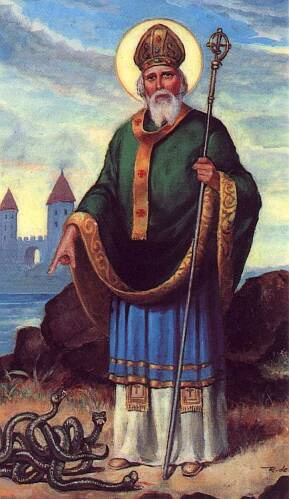
Who Was St. Patrick?
Yesterday many people celebrated St. Patrick's Day. This day is special for me since my great-great-grandmother was from Ireland and my grandma, Esther, went home to be with Jesus on St. Patrick's Day. But it has also become special to me since I have learned the incredible story of St. Patrick!
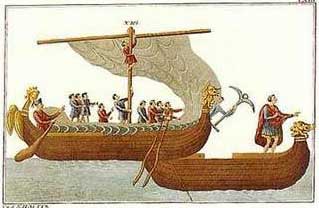
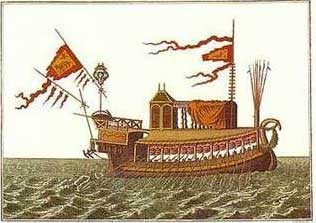
Below is the story of St. Patrick:
This story was found at the website: http://www.irishcultureandcustoms.com/1Kids/StPatrick.html
After St. Patrick died, Ireland was used greatly by God to keep Christianity alive in Europe during the Middle/Dark Ages. At a time when there was much corruption in the Church in Europe and when very few people knew how to read so that it was difficult to spread the Gospel, the Irish/Celtic Church sent out many missionaries and helped preserve the Christian religion through its monasteries. This early Celtic Church flourished with many monks and priests leaving Ireland to begin missions in Europe. In the first two hundred and fifty years after Patrick's death, around five hundred Irish saints were recognized. These missionaries established monasteries in Scotland, England, Switzerland, France, Germany and as far south as Italy.
We have much to be grateful for in the lasting Christian heritage and legacy of Patrick and Ireland!
Thursday, February 14, 2019
The First Valentines Day
Today is Valentines Day...a day for candy, flowers and cards expressing love and commitment. But just like many of our holidays, there's a lot more behind it than just cards and gifts. There's a true-life story. It's a story that teaches us a lot about love, sacrifice and commitment - the true meaning of Valentines Day.
In the third century, the Roman Empire was ruled by Emperor Claudius II Gothicus. He was nicknamed Claudius the Cruel because of his harsh leadership and his tendency for getting into wars and abusing his people. In fact, he was getting into so many wars during the third century that he was having a difficult time recruiting enough soldiers.
Claudius believed that recruitment for the army was down because Roman men did not want to leave their loves or families behind, so he canceled all marriages and engagements in Rome. Thousands of couples saw their hopes of matrimony dashed by the single act of a tyrant. And no one seemed interested in standing up to the emperor.
But a simple Christian priest named Valentine did come forward and stood up for love. He began to secretly marry soldiers before they went off to war, despite the emperor’s orders. In 269 A.D., Emperor Claudius found out about the secret ceremonies. He had Valentine thrown into prison and deemed that he would be put to death.
As Valentine was awaiting execution, he fell in love with a blind girl who happened to be the jailer’s daughter. On the eve of his execution, with no writing instruments available, Valentine is said to have written her a sonnet in ink that he squeezed from violets. Legend has it that his words made the blind woman see again. It was a brief romance because the next day Valentine was clubbed to death by Roman executioners.
St. Valentine gave his life so that young couples could be bonded together in holy matrimony. They may have killed the man, but not his spirit. Even centuries after his death, the story of Valentine’s self-sacrificing commitment to love was legendary in Rome. Eventually, he was granted sainthood and the Catholic Church decided to create a feast in his honor. They picked February 14 as the day of celebration because of the ancient belief that birds (particularly lovebirds, but also owls and doves) began to mate on that very day.
It’s wonderful to know that Valentine’s Day is really founded on the concept of love in marriage.
Taken from Mark Merrill blog
Saturday, September 1, 2018
2.2 Billion People Have Never Heard of Jesus
Praise the LORD, all nations!
Extol him, all peoples!
For great is his steadfast love toward us,
and the faithfulness of the LORD endures forever.
Praise the LORD!
Who Are the "Peoples," the "Nations"?
"Nations" and "peoples" in the Bible don't refer to political states like America, Spain, Brazil, China, but to ethnic or language or cultural groupings in these political states. For example, if you consider the country of China there are at sixty "peoples" in China (Han, Hui, Dulong, Li, Lisu, Shui, Salar, Yao, etc.). And in the Bible you read about, "the Jebusites, the Amorites, the Girgashites, the Hivites, the Arkites, the Sinites, the Arvadites, the Zemarites, and the Hamathites" (Genesis 10:16-18).
So when Psalm 17:1 says, "Praise the LORD, all nations! Extol him, all peoples!" it means, "Praise the Lord, Hui of China! Praise the Lord Bahing of Nepal! Praise the Lord, Baluch of Pakistan! Praise the Lord, Maninka of Guinea! Praise the Lord, Bugis of Indonesia! Praise the Lord, Somali and Dakota of Minneapolis!" These are the kinds of groups Jesus was referring to when he said after his resurrection, "All authority in heaven and on earth has been given to me. Go therefore and make disciples of all nations" (panta ta ethne, same phrase in Psalm 117:1). These are the groups that Jesus meant when he said, "This gospel of the kingdom will be proclaimed throughout the whole world as a testimony to all nations, and then the end will come" (Matthew 24:14).
So a huge question for followers of Jesus today is - or should be - how many peoples are there and how many of them are still unreached with the gospel of the kingdom? How many still have no church who obey Psalm 117 and praise the Lord?
Let's just take one reliable research effort, the Joshua Project which has undertaken to catalog and keep current the unreached people groups in the world. According to their most recent findings Status of World Evangelization they calculate 6,900 ethnic people groups in the world. Of these, 7,000 have less than 2% who are following Christ. By population numbers, that is 42% of the world population (3,140,000,000).
If you hear someone say that the day of missions outreach is over; that everyone has heard about Jesus, they are very mistaken. According to World Christian Encyclopedia, "81% of all Muslims, Buddhists and Hindus do not personally know a Christ-follower." One reason for that is while there are many people who serve on the mission field, "almost 90% of all cross-cultural missionaries labor among nominally Christian people groups, only about 10% among unreached people groups."
29% of the world, 2.16 billion people, have never heard the name of Jesus. If we truly believe what the Bible says, then we must believe that God, the Father of our Lord Jesus is to be praised by all peoples. This 2.16 billion people will perish for eternity without the gospel. God means for us to engage with him to bring about Psalm 117: "Praise the LORD, all nations! Extol him, all peoples!"
If you have children who don't know about the "nations," I suggest that you subscribe to the Global Prayer Digest or visit the website Unreached of the Day . Read a story to them and pray for a different people group each day. Oh, may we be a Church and families where children consider short-term missions as normal as vacations and who consider the dangers and burdens and joys of vocational missions a gift everyone should consider receiving.
May children and teenagers and adults in Christ's Church break free from our tiny little worlds of family and friends and church and Western culture! Jesus Christ is building his church around the world. We are meant to think and feel and work with Him in this cause. Who knows how many of our personal problems are owing to narrowness of thinking and smallness of affections in relation to God's global purposes. May God give us a mind and heart to know and love and reach the peoples of the world for the glory of our Savior!
Let's not be among the number who do not see that the world and the church have changed dramatically in the last 100 years - the greatest missionary century in history. Listen to Andrew Walls from his book, The Cross-Cultural Process in Christian History:
[The twentieth century] has seen this great recession from the Christian faith in the West, there has been an equally massive accession to that faith in the non-Western world. [At the beginning of the century] well over 80 percent of those who professed Christianity lived in Europe or North America. Now, approaching 60 percent live in the southern continents of Africa, Asia, Latin America, and the Pacific, and that proportion grows annually. Christianity began the twentieth century as a Western religion, and indeed, the Western religion; it ended the century as a non-Western religion, on track to become progressively more so. (Maryknoll, NY: Orbis Books, 2002, pp. 63-64)
We are not at the center. God may or may not be done with us in our self-absorbed prosperity in America. But he certainly is putting others on the Christian map to humble us and call us to confess and rejoice that others may be far more effective in finishing the Great Commission than we are. The dynamics of church and missions will never be the same.
This is the new world we live in. It is the world that God is guiding and shaping for his glory. So let's join him in his great global purpose and not be limited in our thinking and feeling and acting to our local concerns. Let's give ourselves to missions, either as a goer or a sender.
This was taken from a sermon, by John Piper, entitled Everlasting Truth for the Joy of All Peoples. You can access it at this website Everlasting Truth
Friday, August 24, 2018
Women Missionaries in the Bible
Were there female missionaries in the Bible that we can look to as examples for the modern-day Christian? The answer is a resounding yes! I have highlighted four such women, but I encourage you to look for more. It once again amazes me how a book, written 2,000 or more years ago, continues to speak to us today, in every area of our lives. God is so good!
Esther, whose name appears in the Bible more often than any other woman's, was an orphan Jewess, reared by her cousin. She was born of a noble Jewish family and carried into captivity when Nebuchadnezzar invaded Jerusalem. Four years later, however, she had risen to the position of queen of the Persian Empire. She was most likely the only one of the king’s court who worshiped the true God. However, as a result of the warning from her cousin Mordecai, the king did not know that she was Jewish. As time went on, she won both his confidence and his love. Her position allowed her to play an incredibly important role in the lives of her people, who had been threatened with destruction.
Mordecai warned Esther that the Jews were to be destroyed at the request of their enemy, Haman. But Esther, if she was willing, might be able to intercede for them. He told her, "Who knows but that you have come to royal position for such a time as this?” (Esther 4:14). In order to seek the king's protection of her people, Esther risked her own life by going unbidden before the king. The end result was the downfall of the wicked Haman, whom the king ordered to be hanged, and the salvation of the Jews.
In today’s day and age, women missionaries are asked, time and again, to approach the throne of grace on behalf of a people group whom Satan has tried to destroy. His methods are varied: cannibalism, violent warfare, infanticide, jihad...but his intent is the same as Haman’s, destruction of the people God has made. A missionary goes before the throne of God to plead for this people, more often than not, risking their lives in order to live and interact with these, sometimes dangerous, people groups. The Lord, time and again, recognizes the sacrifice of these modern-day Esthers, and holds out His scepter of pardon and forgiveness to each people group who is willing to acknowledge Him as Savior and Lord. Yet, it is not only the foreign missionary who does this, but each Christian has the privilege and responsibility to intercede for the lost, praying daily for salvation for the unreached people of our world.
Dorcas, (Acts 9: 36, 39) lived in the port city of Joppa, about 35 miles northwest of Jerusalem. It was an important Christian center in the first century AD, a time when the new faith was spreading from Jerusalem across the Mediterranean. Dorcas had great compassion for the widows and the fatherless. She began making clothing for the poor, rising early each day to sew.
One day she was seized with illness . . . and death came suddenly. Saints in the Church and widows whom she had befriended came to her house to prepare her for burial. Some in the group knew that Peter and other apostles were performing miracles, and a few had faith that she could be raised from the dead. They sent two men over to Lydda where Peter had gone to preach, asking him to travel the ten miles to her home and raise Dorcas from the dead. Such faith!
Peter listened to them, left his preaching at Lydda, and hurried on foot to her house. He dismissed the people who stood around her body weeping, telling them he would pray. After a bit, he was heard to say, "Tabitha, arise" (Acts 9:40). Dorcas opened her eyes, saw Peter and sat up. Then Peter called the saints and widows and presented her to them, alive!
Dorcas is an example of the care and concern that women missionaries extend toward the poor, homeless, orphans and widows. This compassion can be seen throughout history in the lives of women such as Mother Theresa, Amy Carmichael, Gladys Aylward, Elizabeth Elliot, and the list goes on. God has designed women to be especially compassionate...a mother’s heart. This equips them for the very important missionary role of being the hands and feet of Jesus to those who are suffering. This care and concern is often behind-the-scenes, as in the case of Dorcas, but it does not go unseen by the Lord, or by those whose lives have been impacted. Each of us, whether in America or overseas, can reach out to those in need with the love of the Lord, following in the footsteps of Dorcas.
Lydia, Acts 16:14, 40, was a businesswoman in the city of Philippi. She provided purple-dyed textiles which were greatly sought after by the people in the markets. She was easily recognized on the streets of Philippi and would often dress in purple herself. A native of Thyatira in western Asia Minor, she was a Gentile, among Gentiles. But she was set apart because she worshipped the one God of the Jews. In her desire to know better the wonders and powers of the one God, she joined with some other women to become a small group of worshipers.
About this time, Paul and his companion Silas came over from Troas. As they came into the midst of her gathering, she and her companions listened to Paul as he related his story of the new Gospel proclaimed in Jerusalem by Jesus Christ and now spreading westward into Macedonia. As Lydia listened, “the Lord opened her heart to respond to Paul’s message” (Acts 16:14). Believing in what he had to say, Lydia and her household were baptized. Then she said to Paul and Silas, "If you consider me a believer in the Lord, come and stay at my house,” (Acts 16:15). They accepted her hospitality, and in return, she had the opportunity to learn more from them about the Gospel of Jesus Christ.
Her prayers and friendship with Paul continued. It was to her house that Paul and Silas returned when they were released from prison. They had been cast into prison because of the complaint of some men who had been exploiting a demented girl as a soothsayer. Paul healed the child, and the men were angry about their financial loss. Even in prison though, Paul and Silas were fearless Christians. They sang and prayed, and a great earthquake opened the prison doors. The keeper of the prison was so moved at these wonders that he became a convert to the new faith before Paul and Silas departed (Acts 15:40). Arriving at Lydia’s home, they told of their experiences to her and others who gathered to rejoice with them.
Lydia personifies the spirit of hospitality which must be present in every female, and male, missionary. Just as the Lord Jesus throws open the gates of Heaven to welcome every wayward sinner who approaches His throne of grace, the missionary must be willing and eager to open their home, and their lives, to the people who they are trying to reach with the Gospel of Christ. Unlike in America, where much of the art of hospitality has been lost, in the East, hospitality is practiced by most and is one of the best ways for Christians to share the love of Jesus with those around them. It is often over a shared meal that the hearts and minds of those who are searching are enlightened by the Gospel. May we all, as Christians, be willing and ready to show hospitality to those who need to hear the Good News of Jesus.
Priscilla, Acts 18:2, 18, 26 – Romans 16:3 – I Corinthians 16:19 – II Timothy 4:19, was a woman who had an impact for God in at least three different nations: Rome, Greece and Asia Minor. With her husband Aquila, they supported Paul, hosted him in their home, “led a house church, and were assigned by Paul to disciple the eloquent and committed Egyptian Jew, Apollos, ‘instructing him in the way of God more perfectly,’ (Acts 18:26)” (Kraft, 294). Her role in mission outreach did not seem out of the ordinary which leads one to believe that many women were involved in the Great Commission from the beginning.
She and Aquila were tentmakers and teachers. They came out of Italy first to live at Corinth and then about a year and a half later they went to Ephesus. They left Rome at the time when Claudius expelled all Jews. Their home, in the weaving sections of Corinth and Ephesus, became a rendezvous for those wanting to know more about the new Christian faith.
At Corinth, Paul, the tent-making missionary, lived and worked with them. Then when Paul departed from Corinth and embarked for Syria, they went with him. When they reached Ephesus, Paul left them there. Upon taking leave of them, he said, "I will return to you, if God wills," (Acts 18:21). Then he set sail from Ephesus. It was a year or more before Paul returned to them at Ephesus, and he found that they had established a well-organized congregation.
Not long after they arrived in Ephesus, Priscilla and Aquila had the opportunity to teach the eloquent and learned Apollos. He was well versed in the Old Testament Scriptures. He had been introduced to the Christian religion first by John the Baptist, but he had only a superficial knowledge of the new Christian faith, and so they “explained the way of God to him more adequately” (Acts 18:26). He accepted Christ as his Savior and after traveling to Achaia, “he vigorously refuted the Jews in public debate, proving from the Scriptures that Jesus was the Christ,” (Acts 18:28). It was the teaching of Priscilla and Aquila that helped him enter this very public role for Christ.
Priscilla, working as a team with her husband, exemplifies the missionary role of witness, partnership and church planting. They were bold witnesses to Apollos, not being intimidated by his scholarly prowess but sharing the Gospel as people who had been lost to one who was currently lost. In addition, they were first of all partners with each other as all married couples should be on the mission field. Also, their partnership with Paul was evidenced a few times in Scripture.
The Christian life is not meant to be walked alone. God grants other Christians as friends, encouragers and supporters, Priscilla, Aquila and Paul fulfilled this role for each other. Thirdly Priscilla, with her husband, also planted a church in Ephesus, building on the foundation that Paul had set while he was there. Church planting is so very important in today’s mission field...it is one of the pillars. This wife/husband team should be used as an example for any Christian couple who desires to follow God more closely, fulfilling His Great Commission in this world.
In conclusion, one can see through the lives of Esther, Dorcas, Lydia and Priscilla, some of the key roles women of today are asked to take in their desire to fulfill the Great Commission: intercessory prayer, compassion and outreach to the poor, hospitality, witness, partnership and church planting.
(some of these writing attributed to Beverly Whitaker, http://freepages.religions.rootsweb.ancestry.com/~gentutor/Biblewomen.html)
Esther, whose name appears in the Bible more often than any other woman's, was an orphan Jewess, reared by her cousin. She was born of a noble Jewish family and carried into captivity when Nebuchadnezzar invaded Jerusalem. Four years later, however, she had risen to the position of queen of the Persian Empire. She was most likely the only one of the king’s court who worshiped the true God. However, as a result of the warning from her cousin Mordecai, the king did not know that she was Jewish. As time went on, she won both his confidence and his love. Her position allowed her to play an incredibly important role in the lives of her people, who had been threatened with destruction.
Mordecai warned Esther that the Jews were to be destroyed at the request of their enemy, Haman. But Esther, if she was willing, might be able to intercede for them. He told her, "Who knows but that you have come to royal position for such a time as this?” (Esther 4:14). In order to seek the king's protection of her people, Esther risked her own life by going unbidden before the king. The end result was the downfall of the wicked Haman, whom the king ordered to be hanged, and the salvation of the Jews.
In today’s day and age, women missionaries are asked, time and again, to approach the throne of grace on behalf of a people group whom Satan has tried to destroy. His methods are varied: cannibalism, violent warfare, infanticide, jihad...but his intent is the same as Haman’s, destruction of the people God has made. A missionary goes before the throne of God to plead for this people, more often than not, risking their lives in order to live and interact with these, sometimes dangerous, people groups. The Lord, time and again, recognizes the sacrifice of these modern-day Esthers, and holds out His scepter of pardon and forgiveness to each people group who is willing to acknowledge Him as Savior and Lord. Yet, it is not only the foreign missionary who does this, but each Christian has the privilege and responsibility to intercede for the lost, praying daily for salvation for the unreached people of our world.
Dorcas, (Acts 9: 36, 39) lived in the port city of Joppa, about 35 miles northwest of Jerusalem. It was an important Christian center in the first century AD, a time when the new faith was spreading from Jerusalem across the Mediterranean. Dorcas had great compassion for the widows and the fatherless. She began making clothing for the poor, rising early each day to sew.
One day she was seized with illness . . . and death came suddenly. Saints in the Church and widows whom she had befriended came to her house to prepare her for burial. Some in the group knew that Peter and other apostles were performing miracles, and a few had faith that she could be raised from the dead. They sent two men over to Lydda where Peter had gone to preach, asking him to travel the ten miles to her home and raise Dorcas from the dead. Such faith!
Peter listened to them, left his preaching at Lydda, and hurried on foot to her house. He dismissed the people who stood around her body weeping, telling them he would pray. After a bit, he was heard to say, "Tabitha, arise" (Acts 9:40). Dorcas opened her eyes, saw Peter and sat up. Then Peter called the saints and widows and presented her to them, alive!
Dorcas is an example of the care and concern that women missionaries extend toward the poor, homeless, orphans and widows. This compassion can be seen throughout history in the lives of women such as Mother Theresa, Amy Carmichael, Gladys Aylward, Elizabeth Elliot, and the list goes on. God has designed women to be especially compassionate...a mother’s heart. This equips them for the very important missionary role of being the hands and feet of Jesus to those who are suffering. This care and concern is often behind-the-scenes, as in the case of Dorcas, but it does not go unseen by the Lord, or by those whose lives have been impacted. Each of us, whether in America or overseas, can reach out to those in need with the love of the Lord, following in the footsteps of Dorcas.
Lydia, Acts 16:14, 40, was a businesswoman in the city of Philippi. She provided purple-dyed textiles which were greatly sought after by the people in the markets. She was easily recognized on the streets of Philippi and would often dress in purple herself. A native of Thyatira in western Asia Minor, she was a Gentile, among Gentiles. But she was set apart because she worshipped the one God of the Jews. In her desire to know better the wonders and powers of the one God, she joined with some other women to become a small group of worshipers.
About this time, Paul and his companion Silas came over from Troas. As they came into the midst of her gathering, she and her companions listened to Paul as he related his story of the new Gospel proclaimed in Jerusalem by Jesus Christ and now spreading westward into Macedonia. As Lydia listened, “the Lord opened her heart to respond to Paul’s message” (Acts 16:14). Believing in what he had to say, Lydia and her household were baptized. Then she said to Paul and Silas, "If you consider me a believer in the Lord, come and stay at my house,” (Acts 16:15). They accepted her hospitality, and in return, she had the opportunity to learn more from them about the Gospel of Jesus Christ.
Her prayers and friendship with Paul continued. It was to her house that Paul and Silas returned when they were released from prison. They had been cast into prison because of the complaint of some men who had been exploiting a demented girl as a soothsayer. Paul healed the child, and the men were angry about their financial loss. Even in prison though, Paul and Silas were fearless Christians. They sang and prayed, and a great earthquake opened the prison doors. The keeper of the prison was so moved at these wonders that he became a convert to the new faith before Paul and Silas departed (Acts 15:40). Arriving at Lydia’s home, they told of their experiences to her and others who gathered to rejoice with them.
Lydia personifies the spirit of hospitality which must be present in every female, and male, missionary. Just as the Lord Jesus throws open the gates of Heaven to welcome every wayward sinner who approaches His throne of grace, the missionary must be willing and eager to open their home, and their lives, to the people who they are trying to reach with the Gospel of Christ. Unlike in America, where much of the art of hospitality has been lost, in the East, hospitality is practiced by most and is one of the best ways for Christians to share the love of Jesus with those around them. It is often over a shared meal that the hearts and minds of those who are searching are enlightened by the Gospel. May we all, as Christians, be willing and ready to show hospitality to those who need to hear the Good News of Jesus.
Priscilla, Acts 18:2, 18, 26 – Romans 16:3 – I Corinthians 16:19 – II Timothy 4:19, was a woman who had an impact for God in at least three different nations: Rome, Greece and Asia Minor. With her husband Aquila, they supported Paul, hosted him in their home, “led a house church, and were assigned by Paul to disciple the eloquent and committed Egyptian Jew, Apollos, ‘instructing him in the way of God more perfectly,’ (Acts 18:26)” (Kraft, 294). Her role in mission outreach did not seem out of the ordinary which leads one to believe that many women were involved in the Great Commission from the beginning.
She and Aquila were tentmakers and teachers. They came out of Italy first to live at Corinth and then about a year and a half later they went to Ephesus. They left Rome at the time when Claudius expelled all Jews. Their home, in the weaving sections of Corinth and Ephesus, became a rendezvous for those wanting to know more about the new Christian faith.
At Corinth, Paul, the tent-making missionary, lived and worked with them. Then when Paul departed from Corinth and embarked for Syria, they went with him. When they reached Ephesus, Paul left them there. Upon taking leave of them, he said, "I will return to you, if God wills," (Acts 18:21). Then he set sail from Ephesus. It was a year or more before Paul returned to them at Ephesus, and he found that they had established a well-organized congregation.
Not long after they arrived in Ephesus, Priscilla and Aquila had the opportunity to teach the eloquent and learned Apollos. He was well versed in the Old Testament Scriptures. He had been introduced to the Christian religion first by John the Baptist, but he had only a superficial knowledge of the new Christian faith, and so they “explained the way of God to him more adequately” (Acts 18:26). He accepted Christ as his Savior and after traveling to Achaia, “he vigorously refuted the Jews in public debate, proving from the Scriptures that Jesus was the Christ,” (Acts 18:28). It was the teaching of Priscilla and Aquila that helped him enter this very public role for Christ.
Priscilla, working as a team with her husband, exemplifies the missionary role of witness, partnership and church planting. They were bold witnesses to Apollos, not being intimidated by his scholarly prowess but sharing the Gospel as people who had been lost to one who was currently lost. In addition, they were first of all partners with each other as all married couples should be on the mission field. Also, their partnership with Paul was evidenced a few times in Scripture.
The Christian life is not meant to be walked alone. God grants other Christians as friends, encouragers and supporters, Priscilla, Aquila and Paul fulfilled this role for each other. Thirdly Priscilla, with her husband, also planted a church in Ephesus, building on the foundation that Paul had set while he was there. Church planting is so very important in today’s mission field...it is one of the pillars. This wife/husband team should be used as an example for any Christian couple who desires to follow God more closely, fulfilling His Great Commission in this world.
In conclusion, one can see through the lives of Esther, Dorcas, Lydia and Priscilla, some of the key roles women of today are asked to take in their desire to fulfill the Great Commission: intercessory prayer, compassion and outreach to the poor, hospitality, witness, partnership and church planting.
(some of these writing attributed to Beverly Whitaker, http://freepages.religions.rootsweb.ancestry.com/~gentutor/Biblewomen.html)
Wednesday, February 14, 2018
Valentines Day and its Beginnings
Today is Valentines Day...a day for candy, flowers and cards expressing love and commitment. But just like many of our holidays, there's a lot more behind it than just cards and gifts. There's a true-life story. It's a story that teaches us a lot about love, sacrifice and commitment - the true meaning of Valentines Day.
In the third century, the Roman Empire was ruled by Emperor Claudius II Gothicus. He was nicknamed Claudius the Cruel because of his harsh leadership and his tendency for getting into wars and abusing his people. In fact, he was getting into so many wars during the third century that he was having a difficult time recruiting enough soldiers.
Claudius believed that recruitment for the army was down because Roman men did not want to leave their loves or families behind, so he canceled all marriages and engagements in Rome. Thousands of couples saw their hopes of matrimony dashed by the single act of a tyrant. And no one seemed interested in standing up to the emperor.
But a simple Christian priest named Valentine did come forward and stood up for love. He began to secretly marry soldiers before they went off to war, despite the emperor’s orders. In 269 A.D., Emperor Claudius found out about the secret ceremonies. He had Valentine thrown into prison and deemed that he would be put to death.
As Valentine was awaiting execution, he fell in love with a blind girl who happened to be the jailer’s daughter. On the eve of his execution, with no writing instruments available, Valentine is said to have written her a sonnet in ink that he squeezed from violets. Legend has it that his words made the blind woman see again. It was a brief romance because the next day Valentine was clubbed to death by Roman executioners.
St. Valentine gave his life so that young couples could be bonded together in holy matrimony. They may have killed the man, but not his spirit. Even centuries after his death, the story of Valentine’s self-sacrificing commitment to love was legendary in Rome. Eventually, he was granted sainthood and the Catholic Church decided to create a feast in his honor. They picked February 14 as the day of celebration because of the ancient belief that birds (particularly lovebirds, but also owls and doves) began to mate on that very day.
It’s wonderful to know that Valentine’s Day is really founded on the concept of love in marriage.
Taken from Mark Merrill blog
Preparing for Easter thru Lent
Today is Ash Wednesday...the beginning of the Easter or Lenten season. This time will culminate with Good Friday on March 30th and Easter on April 1st. This is the greatest celebration for Christians, yet for many children, mine included, it often revolves around Easter egg hunts and candy with very little reflection on what this most holiest of days really means.
"Easter egg hunts and chocolate candies inspire great enthusiasm in children! But how can we as Christian parents inspire in our children appreciation for Jesus' death and excitement for His resurrection?
It is the Christmas dilemma all over again, except that Christmas is easier in some respects. Children readily grasp the idea of a sweet little baby in a manger. Stars, angels and sheep on a hillside form lovely pictures in a child's mind.
Easter is a bit trickier, however. The cross is not a comfortable image. Suffering and death are subjects that most adults want to avoid, and they certainly don't relish tackling them with their young children," Ann Hibbard from Family Celebrations at Easter. I will be drawing much of the ideas for the following Lenten devotions from her book as well as Ann Voskamp's Trail to the Tree
So how to make Easter meaningful for our children? I believe that if we, as parents, can spend a few minutes every day sharing from the Bible the story of Easter, we can help our children and ourselves understand and embrace the Easter message. Just like we prepare for Christmas with the Advent season, we can prepare for Easter with the Lenten season.
The Lenten season begins today. I will do my best to post a Lenten devotion for each day of Lent until Easter. I pray these devotions will help you and your children learn more about the meaning of Easter and draw closer to Jesus Christ.
I will also include any resources that I have found which do a good job of sharing the Easter story with children. If you, as my reader, have any suggestions, please share them and I will post them daily.
Tuesday, February 6, 2018
Pray for North Korea
The eyes of the world will be on South Korea this week as the Olympics unfold in this beautiful country. But their neighbor to the north, North Korea, was named the worst persecutor of Christians in the world for the seventeenth year in a row by Open Doors. The conditions for Christians inside this politically closed, spiritually dark country are considered “extremely harsh,” with untold thousands imprisoned for their faith, many of them tortured and some used as human guinea pigs for testing biological and chemical weapons.
While the international community is legitimately concerned about North Korea’s nuclear ambitions, the world seems to be overlooking the ongoing and serious human rights violations being carried out by the repressive regime of Kim Jong Il.
Among the many atrocities taking place in North Korea is one of purposeful neglect. Though the leaders of the nation live in opulence, millions of citizens have died in famines that have ravaged the population since the 1990s. One study estimated that in 2006, 37% of the nation’s children were undernourished and more than 24% were underweight.
The national religion of North Korea is an ideology called Juche, developed by former leader, Kim Il Sung. Juche is a form of emperor worship that “centers on the worship of the country’s leaders.”
“Every religious activity,” notes Open Doors, “is recognized as an insurrection to the North Korean socialist principles.” The government has been especially zealous in its attempts to eradicate Christianity. “The people have been taught that Christians are ‘crazy people.’” Those who follow Jesus must worship underground. If they are discovered, they face arrest, torture, imprisonment and, often death.
Untold thousands of Believers are currently languishing in dozens of North Korean labor camps located throughout the nation. Along with torture, some are subject to chemical and biological weapons testing.
“In spite of these inhuman circumstances,” reports Open Doors, “Christianity is growing and the chances to hear the Gospel are growing especially for those who live in nearby China.”
North Korea is listed as the number one persecutor of Christians in the world on the Open Doors World Watch List 2018 of the top countries that are the worst persecutors of Christians in the world.
PRAY FOR:
the heart of Kim Jong Un and the other leaders of North Korea to be transformed by a personal encounter with Jesus Christ. (The Bible, II Corinthians 5:17)
an immediate end to the barbaric treatment of Christians and other citizens considered to be a threat to the repressive government. Pray for this mistreatment and abuse to be made public, capture the attention of the media, and for international governments to call for it to cease right away. (The Bible, Hebrews 4:13)
the Light of Christ to shine throughout this darkened nation. (The Bible, I Peter 2:9)
the Lord to be present with Believers who have been imprisoned, those being tortured, and with families who have lost loved ones. Pray for the Lord to comfort, strengthen, and encourage them. (The Bible, II Corinthians 1:3-5)
the Gospel to continue to spread in North Korea. Pray for Christians to share their faith with boldness, seeking to honor the Lord, despite fierce resistance. (The Bible, Ephesians 6:19,20)
Pray Christian Believers will be strong in the Lord and in the power of His might. (The Bible, Ephesians 6:10)
the Kingdom of God to come to North Korea with great and awesome power. Pray for the Holy Spirit to move among the people, drawing multitudes into relationship with Jesus Christ as Savior and Lord today. Pray they will be discipled in the ways of the Kingdom of Heaven. (The Bible, John 6:44)
Sources: Open Doors, Voice of the Martyrs, Barnabas Fund, Window International Network
Thursday, November 23, 2017
Squanto - A Special Instrument of God
On this Thanksgiving day I'd like to share the true story of Squanto...the Native American who helped the Pilgrims survive that first year.
Historical accounts of Squanto's life vary, but historians believe that around 1608, more than a decade before the Pilgrims arrived, a group of English traders sailed to what is today Plymouth, Massachusetts. When the trusting Wampanoag Indians came out to trade, the traders took them prisoner, transported them to Spain, and sold them into slavery. It was an unimaginable horror.
But God had an amazing plan for one of the captured Indians, a boy named Squanto.
Squanto was bought by a well-meaning Spanish monk, who treated him well and taught him the Christian faith. Squanto eventually made his way to England and worked in the stables of a man named John Slaney. Slaney sympathized with Squanto's desire to return home, and he promised to put the Indian on the first vessel bound for America.
It wasn't until 1619, ten years after Squanto was first kidnapped, that a ship was found. Finally, after a decade of exile and heartbreak, Squanto was on his way home.
But when he arrived in Massachusetts, more heartbreak awaited him. An epidemic had wiped out Squanto's entire village.
We can only imagine what must have gone through Squanto's mind. Why had God allowed him to return home, against all odds, only to find his loved ones dead?
A year later, the answer came. A shipload of English families arrived and settled on the very land once occupied by Squanto's people. Squanto went to meet them, greeting the startled Pilgrims in English.
According to the diary of Pilgrim Governor William Bradford, Squanto "became a special instrument sent of God for [our] good . . . He showed [us] how to plant [our] corn, where to take fish and to procure other commodities . . . and was also [our] pilot to bring [us] to unknown places for [our] profit, and never left [us] till he died."
When Squanto lay dying of fever, Bradford wrote that their Indian friend "desir[ed] the Governor to pray for him, that he might go to the Englishmen's God in heaven." Squanto bequeathed his possessions to the Pilgrims "as remembrances of his love."
Who but God could so miraculously convert a lonely Indian and then use him to save a struggling band of Englishmen? It is reminiscent of the biblical story of Joseph, who was also sold into slavery, and whom God likewise used as a special instrument for good.
Friday, March 17, 2017
Who Was St. Patrick?
Happy St. Patrick's Day! This day is special for me since my great-great-grandmother was from Ireland and my grandma, Esther, went home to be with Jesus on St. Patrick's Day, 18 years ago. But it has also become special to me since I have learned the incredible story of St. Patrick!
Below is the story of St. Patrick:
This story was found at the website: http://www.irishcultureandcustoms.com/1Kids/StPatrick.html
After St. Patrick died, Ireland was used greatly by God to keep Christianity alive in Europe during the Middle/Dark Ages. At a time when there was much corruption in the Church in Europe and when very few people knew how to read so that it was difficult to spread the Gospel, the Irish/Celtic Church sent out many missionaries and helped preserve the Christian religion through its monasteries. This early Celtic Church flourished with many monks and priests leaving Ireland to begin missions in Europe. In the first two hundred and fifty years after Patrick's death, around five hundred Irish saints were recognized. These missionaries established monasteries in Scotland, England, Switzerland, France, Germany and as far south as Italy.
We have much to be grateful for in the lasting Christian heritage and legacy of Patrick and Ireland!
Saturday, November 21, 2015
Squanto - A Special Instrument of God
As Thanksgiving approaches I'd like to share the true story of Squanto...the Native American who helped the Pilgrims survive that first year.
Historical accounts of Squanto's life vary, but historians believe that around 1608, more than a decade before the Pilgrims arrived, a group of English traders sailed to what is today Plymouth, Massachusetts. When the trusting Wampanoag Indians came out to trade, the traders took them prisoner, transported them to Spain, and sold them into slavery. It was an unimaginable horror.
But God had an amazing plan for one of the captured Indians, a boy named Squanto.
Squanto was bought by a well-meaning Spanish monk, who treated him well and taught him the Christian faith. Squanto eventually made his way to England and worked in the stables of a man named John Slaney. Slaney sympathized with Squanto's desire to return home, and he promised to put the Indian on the first vessel bound for America.
It wasn't until 1619, ten years after Squanto was first kidnapped, that a ship was found. Finally, after a decade of exile and heartbreak, Squanto was on his way home.
But when he arrived in Massachusetts, more heartbreak awaited him. An epidemic had wiped out Squanto's entire village.
We can only imagine what must have gone through Squanto's mind. Why had God allowed him to return home, against all odds, only to find his loved ones dead?
A year later, the answer came. A shipload of English families arrived and settled on the very land once occupied by Squanto's people. Squanto went to meet them, greeting the startled Pilgrims in English.
According to the diary of Pilgrim Governor William Bradford, Squanto "became a special instrument sent of God for [our] good . . . He showed [us] how to plant [our] corn, where to take fish and to procure other commodities . . . and was also [our] pilot to bring [us] to unknown places for [our] profit, and never left [us] till he died."
When Squanto lay dying of fever, Bradford wrote that their Indian friend "desir[ed] the Governor to pray for him, that he might go to the Englishmen's God in heaven." Squanto bequeathed his possessions to the Pilgrims "as remembrances of his love."
Who but God could so miraculously convert a lonely Indian and then use him to save a struggling band of Englishmen? It is reminiscent of the biblical story of Joseph, who was also sold into slavery, and whom God likewise used as a special instrument for good.
Sunday, March 16, 2014
Happy St. Patrick's Day!
Happy St. Patrick's Day! This day is special for me since my great-great-grandmother was from Ireland and my grandma, Esther, went home to be with Jesus on St. Patrick's Day, 15 years ago. But it has also become special to me since I have learned the incredible story of St. Patrick!
Below is the story of St. Patrick:
This story was found at the website: http://www.irishcultureandcustoms.com/1Kids/StPatrick.html
After St. Patrick died, Ireland was used greatly by God to keep Christianity alive in Europe during the Middle/Dark Ages. At a time when there was much corruption in the Church in Europe and when very few people knew how to read so that it was difficult to spread the Gospel, the Irish/Celtic Church sent out many missionaries and helped preserve the Christian religion through its monasteries. This early celtic Church flourished with many monks and priests leaving Ireland to begin missions in Europe. In the first two hundred and fifty years after Patrick's death, around five hundred Irish saints were recognized. These missionaries established monasteries in Scotland, England, Switzerland, France, Germany and as far south as Italy.
We have much to be grateful for in the lasting Christian heritage and legacy of Patrick and Ireland!
Saturday, March 16, 2013
Happy St. Patrick's Day
Happy St. Patrick's Day! This day is special for me since my great-great-grandmother was from Ireland and my grandma, Esther, went home to be with Jesus on St. Patrick's Day, 14 years ago. But it has also become special to me since I have learned the incredible story of St. Patrick!
Below is the story of St. Patrick:
This story was found at the website: http://www.irishcultureandcustoms.com/1Kids/StPatrick.html
After St. Patrick died, Ireland was used greatly by God to keep Christianity alive in Europe during the Middle/Dark Ages. At a time when there was much corruption in the Church in Europe and when very few people knew how to read so that it was difficult to spread the Gospel, the Irish/Celtic Church sent out many missionaries and helped preserve the Christian religion through its monasteries. This early celtic Church flourished with many monks and priests leaving Ireland to begin missions in Europe. In the first two hundred and fifty years after Patrick's death, around five hundred Irish saints were recognized. These missionaries established monasteries in Scotland, England, Switzerland, France, Germany and as far south as Italy.
We have much to be grateful for in the lasting Christian heritage and legacy of Patrick and Ireland!
Tuesday, February 19, 2013
Easter Devotion: Boldness in Action (Day 6)
As Jesus approached Jericho, a blind man was sitting by the roadside begging. When he heard the crowd going by, he asked what was happening. They told him, "Jesus of Nazareth is passing by."
He called out, "Jesus, Son of David, have mercy on me!"
Those who led the way rebuked him and told him to be quiet, but he shouted all the more, "Son of David, have mercy on me!"
Jesus stopped and ordered the man to be brought to him. When he came near, Jesus asked him, "What do you want me to do for you?"
"Lord, I want to see," he replied.
Jesus said to him, "Receive your sight; your faith has healed you."
Immediately he received his sight and followed Jesus, praising God. When all the people saw it, they also praised God. Luke 18:35-43
Discuss
1) What did the blind man do when he heard that Jesus was passing by?
2) Why did people rebuke/scold him and tell him to be quiet?
3) What did he do when they hushed him? Why?
4) When Jesus healed him, what did Jesus say had healed him?
5) Do you ever get embarrassed to tell others you are a Christian? If so, what lesson can you learn from the blind man?
6) What was the response of the people, who had previously scolded the blind man, once he was healed by Jesus?
7) Do you think your boldness for Jesus can bring praise to Him from other people?
Final Thought
Jesus was not embarrassed by the blind man's loud cries. He loved to see faith like that of the blind man, bold and persistent. It was a faith that 1) didn't care what others thought, 2) directly admitted his need and 3) followed Jesus immediately and gladly with a heart full of praise.
Prayer
Ask God to help you be more bold for Him and to trust that when you pray to Him, He hears you.
Song - Take My Life and Let It Be
Take my life and let it be
Consecrated, Lord, to Thee.
Take my hands and let them move
At the impulse of Thy love
Take my feet and let them be
Swift and beautiful for Thee.
Take my voice and let me sing,
Always, only for my King.
Take my lips and let them be
Filled with messages from Thee.
Take my silver and my gold,
Not a mite would I withhold.
Not a mite would I withhold
Take my love, my Lord, I pour
At Thy feet its treasure store.
Take myself and I will be
Ever, only, all for Thee.
Take my life and let it be
Consecrated Lord to Thee
Take myself and I will be
Ever, only, all for Thee
Here is a link for music and lyrics - Song
For further study
There are many children throughout the world who are very bold in their faith in Christ, especially in nations where it is hard to be a Christian. Sharing their stories can encourage a bolder faith in your children. A wonderful resource is Kids of Courage
* Some of the content of this blog is based on the book Family Celebrations at Easter by Ann Hibbard.*
Subscribe to:
Posts (Atom)


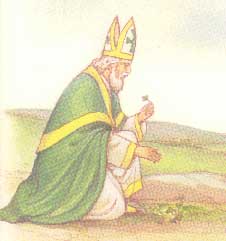
One day, I was telling the people about God. They did not understand. So I picked a shamrock and showed them that there are three leaves but only one plant. Then the people could better understand that the Father, Son, and Holy Spirit make only one God. That is why, when you see a picture of me, I am usually holding a shamrock.